
How Homebuyers Can Use Zillow Effectively Without Falling for Zestimate Pitfalls

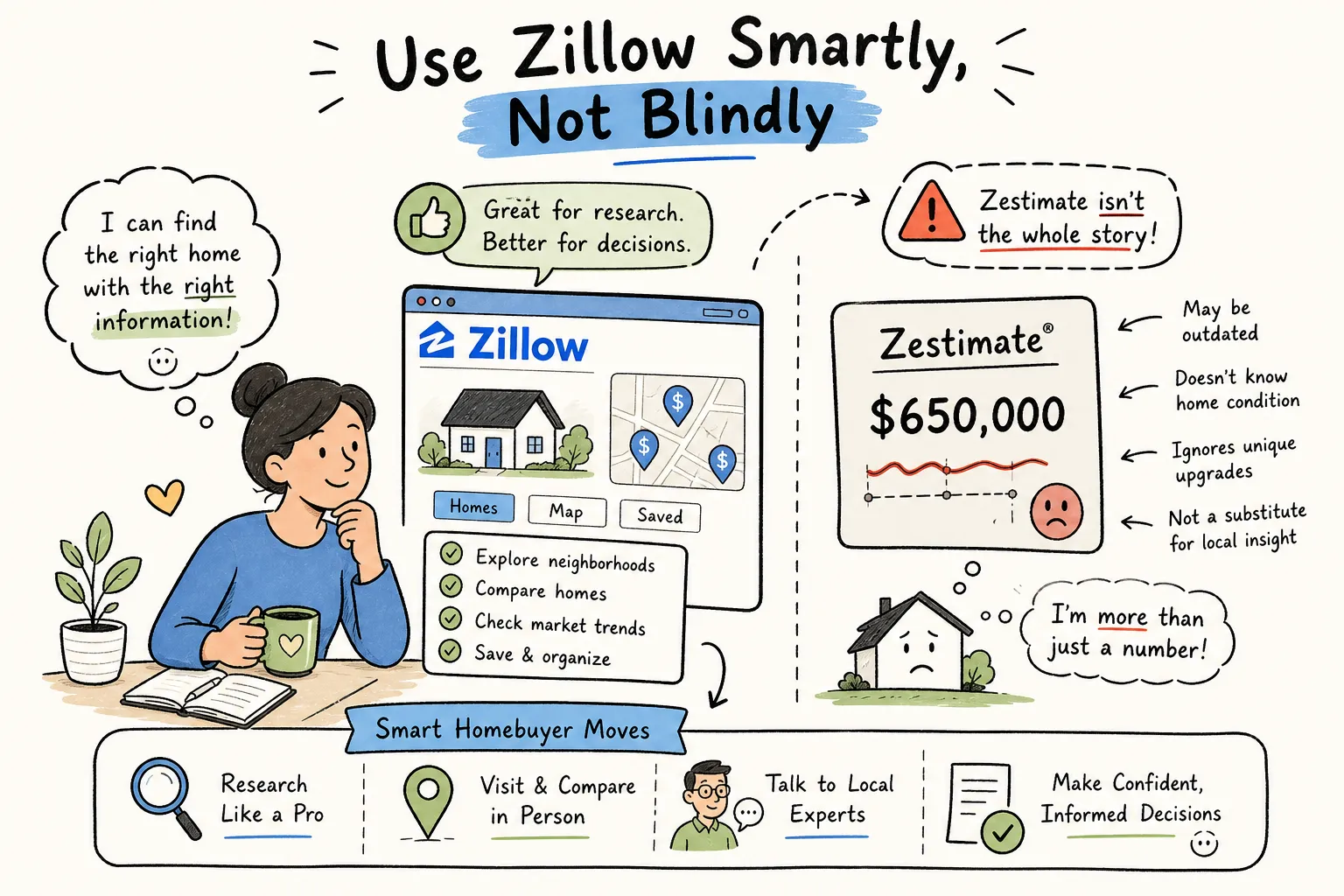
Zillow is genuinely useful. That is not the debate. Millions of buyers start their home search there, and the platform has made real estate more transparent than it has ever been. But useful and reliable are not the same thing, and the gap between those two words can cost you real money. In my years working with buyers and sellers, the most common mistake I see starts on this platform, not because it is bad, but because most people don't understand what it's actually showing them.
By the time you finish this article, you'll know how to search homes for sale on Zillow without wasting hours on dead ends, what the Zestimate is actually measuring and where it breaks down, which filters matter most, and exactly where a local agent fills the gaps that no algorithm can close.
What Zillow actually shows you (and what it doesn't)
The difference between MLS listings, FSBO entries, and off-market data
The site pulls from several different sources, and not all of them carry the same data quality. MLS-fed listings come from brokerages and are generally the most accurate and complete: verified square footage, confirmed status, and listing details entered by a licensed professional. FSBO listings are entered directly by homeowners, which means quality depends entirely on what the seller chooses to include. Off-market entries rely on public records like tax assessments and permit data, which are often months or years out of date.
That mix of sources is both the platform's greatest strength and its most significant weakness. The breadth of inventory is impressive. The inconsistency beneath it is something buyers need to understand before they start making decisions based on what they see.
The core tools worth actually using
Several features on the site genuinely deliver value in the early stages of a property search. Map-based search lets you draw a custom boundary around the exact area you care about. Price history shows you how a listing has moved since it first hit the market. Days on market is one of the most underused signals available: a home sitting for 60 days is telling you something, typically that the price, condition, or presentation isn't connecting with buyers. The Zillow app also offers 3D tours, interactive floor plans, and neighborhood overlays that are legitimately helpful for narrowing a search from a distance.
The right frame for all of these tools is research, not decision-making. They are excellent for narrowing your list and building context. They are not reliable enough to commit to an offer price or skip a professional valuation. Keep that boundary clear and the platform becomes much more useful.
The Zestimate explained: what that number really means
How Zillow calculates the Zestimate (the honest version)
The Zestimate is an automated valuation model built on a neural network. It is not an appraisal performed by someone who has walked through the property. No licensed appraiser, no physical inspection, no professional judgment about condition. The model runs on inputs: square footage, bedroom and bathroom count, lot size, property age, location, public tax records, prior sales, permit history, MLS listing data, user-submitted updates like renovation notes, and local market trends.
The platform also displays a Zestimate range alongside the headline number, and that range reflects the model's own uncertainty. On a straightforward suburban home with recent comparable sales nearby, the range might be tight. On a rural property, a historic home, or anything unusual for its area, the range can span tens of thousands of dollars in either direction. When you see that range, take it seriously.
On-market accuracy vs. off-market reality (with actual numbers)
Here is where the Zestimate earns its reputation for frustrating buyers and sellers. For homes actively listed on the market, the current national median error rate sits at approximately 1.78% (per Zillow's published accuracy metrics). That means half of Zestimates are within 1.78% of the eventual sale price for listed homes. That is a reasonably useful ballpark. For off-market homes, that median error jumps to around 7.2%. Half of those estimates are off by more than 7.2% in either direction.
Run the math on a real number. A 7.2% error on a $500,000 home equals a typical absolute difference of $36,000. And that is the median: half the off-market estimates are off by more than that amount. The buyer who walked in with the printout was not doing anything wrong. She just didn't know that the Zestimate on an off-market property is essentially a rough census estimate, not a market valuation. Use it to get a general sense of a price range. Never use it to set an offer or a listing price without a comparative market analysis from a licensed agent to support it.
How to filter and search Zillow listings without wasting time
Setting filters that actually narrow your results
The most effective filter sequence starts broad and layers in. Begin with location using a city, ZIP code, or a custom-drawn map boundary. Set your price range next, then select home type: house, condo, townhouse, multi-family, or lot. From there, add bedrooms, bathrooms, and square footage minimums. Each filter you add narrows your results further, so add them in order of priority to avoid filtering yourself into an empty result set.
Two filters most buyers skip are worth highlighting. The school district filter lets you select a school level and rating, then click "View homes this school serves" to see listings within a verified attendance boundary. That is genuinely useful, but always confirm boundaries directly with the school district before making decisions based on them: boundaries change, and the site does not update them in real time. The "Days on Zillow" filter is the other one. Filtering for listings under 7 days surfaces fresh inventory fast, which matters in competitive markets where homes disappear in hours.
Setting up alerts and saved searches the right way
Once you have a filter set that returns relevant results, save it. The platform lets you name the search and choose your alert frequency: instant, daily, or off. In an active market, choose instant. The Zillow app sends push alerts faster than email, and in a market where new listings go under contract within 24 to 48 hours, getting notified sooner rather than later matters.
Keep your alert criteria tight enough to stay relevant. A saved search that sends you 30 notifications a day trains you to ignore them. Set your price range, home type, and bedroom count precisely enough that every alert is actually worth opening. If you find yourself dismissing notifications without reading them, narrow the criteria further.
Where Zillow falls short and how to catch the gaps
Why listing status is often behind reality
The site updates from MLS syndication feeds, and those feeds introduce a timing gap. Status changes typically reflect within 24 hours, but the window can stretch to 48 hours depending on the market and brokerage. A licensed agent looking at the MLS directly sees changes in near real time, often within minutes of a listing agent entering an update. That gap matters enormously in fast-moving markets.
The practical consequence: a home showing as "Active" on the site may already be under contract or pending in the MLS. Buyers who call on a listing only to hear "that one went pending two days ago" are experiencing that lag directly. Realtor.com generally relies on more direct MLS feeds and tends to reflect pending and sold status faster. Redfin updates quickly in markets where its MLS integration is strong. Neither is a replacement for calling the listing agent directly to confirm before scheduling a tour.
What a local agent gives you that Zillow can't
MLS access, real-time data, and neighborhood context
Licensed agents access the local MLS directly. That means real-time listing status, full showing history, seller disclosures, days on market without price reductions counted separately, and comparable sales data that public-facing tools don't fully surface. When an agent pulls a comparative market analysis, they are working from verified closed transactions: actual sale prices, not list prices, with details about condition, concessions, and terms that never appear in a public listing.
The layer that no algorithm replicates is neighborhood knowledge built from time on the ground. Which streets have significant traffic. Which pockets within a ZIP code are appreciating faster than the overall market. Which listing photos were shot with a wide-angle lens that makes an 11-by-11 bedroom look like a primary suite. That layer is the actual gap between a platform search and an informed buying decision. Data surfaces the possibilities; local knowledge tells you which ones are actually worth pursuing.
How M. Gina Dos Santos approaches a property search for her clients
Every buyer search at www.ginadossantos.com starts with a real conversation: goals, budget, timeline, and the features that are genuinely non-negotiable versus the ones that would be nice. From there, an MLS search calibrated to actual market conditions replaces or supplements whatever the buyer has already found online. Clients get honest assessments of what they are looking at, including what the listing photos aren't showing and what the price history actually means in context.
For sellers, pricing strategy starts from verified comparable sales, not from a Zestimate that doesn't account for a recently replaced roof, an outdated kitchen, or a floor plan that buyers in that market consistently pass on. The Zestimate is a starting conversation, not a pricing strategy. If you want to start a personalized property search or talk through what your home is actually worth in today's market, reach out to M. Gina Dos Santos directly through her Lofty profile for a free consultation. No pressure, no obligation.
Common questions about searching for homes online
Is the Zestimate reliable enough to base an offer on? No. The Zestimate is a useful starting reference, not a valuation. On off-market homes, the national median error is approximately 7.2% (per Zillow's published accuracy metrics), which translates to a typical difference of tens of thousands of dollars on a mid-range home. Individual errors frequently exceed the median. Use a comparative market analysis from your agent before any offer, full stop.
Can you find off-market homes on Zillow? The platform shows some off-market properties through public records data, but inventory is limited and data accuracy is lower on those entries. An agent with direct MLS access can surface pre-market and pocket listings that rarely appear on any public platform, often accessible primarily through professional relationships and MLS networks.
Is Zillow better than Redfin for searching local listings? Each has trade-offs. The former has broader total inventory, including FSBO listings and rentals alongside MLS-fed properties. Redfin updates faster in markets where its MLS integration is strong, which matters when listing status accuracy is a priority. For serious buyers, using both alongside an agent's MLS search gives the most complete picture of available inventory.
Should sellers list FSBO on Zillow without an agent? A FSBO listing is free to post, but it does not enter the MLS, which significantly limits exposure to buyer's agents and their clients. Sellers who go FSBO also take on pricing, disclosures, negotiations, and contract responsibilities themselves. For most sellers, the trade-off in reach and risk makes working with a licensed agent the stronger choice, both financially and practically.
Use Zillow to start. Use a real person to finish.
Zillow is a powerful discovery tool, not a real estate expert. Use it to identify possibilities, track price history, and build your initial sense of a market. Use a real person to verify what you find and act on it with confidence.
The Zestimate takeaway is simple: know what the number is measuring, know where it breaks down, and never let it set your ceiling or floor without verified comparable sales analysis to support it. A 7.2% median error sounds abstract until it represents $36,000 on a single purchase decision.
For buyers and sellers who want the full picture, real-time MLS data, honest neighborhood context, and a straight conversation about what a home is actually worth, M. Gina Dos Santos is available for a free consultation. The platform gets you started. The right agent gets you home.
Schedule your meeting here: https://bit.ly/4shuOhH or by scanning QR code:

Categories
Recent Posts